
When choosing a golf hitting mat, the base material plays an important role in determining its durability, stability, comfort and overall performance. EVA and NBR are two commonly used materials for golf hitting mats, but they offer different characteristics and are suitable for different applications. Understanding the difference between EVA foam and NBR rubber can help golf facility owners, distributors, wholesalers and golf simulator users select the right golf mat for their specific needs.
EVA, or Ethylene Vinyl Acetate, is a lightweight closed-cell foam material widely used in golf hitting mats, practice mats and other sports flooring products. EVA foam is known for its softness, flexibility, cushioning properties and relatively low weight. These characteristics make EVA a popular choice for portable golf hitting mats and personal practice mats.
One of the main advantages of EVA foam is its excellent cushioning effect. When a golfer hits a golf ball, the club generates significant impact and vibration. EVA foam can absorb part of this impact, helping create a more comfortable hitting surface. It can also reduce the amount of vibration transferred from the mat to the floor, which is particularly useful for indoor golf practice.
Another benefit of EVA is its lightweight construction. Compared with rubber-based materials such as NBR, EVA golf mats are generally easier to move, install and store. This makes them suitable for home golf practice, portable golf hitting stations, temporary practice areas and users who need to frequently move their golf mat.
EVA is also relatively cost-effective. For manufacturers, EVA foam can provide a good balance between performance and production cost. As a result, EVA golf mats are often used in entry-level, residential and portable golf practice applications where low weight and competitive pricing are important considerations.
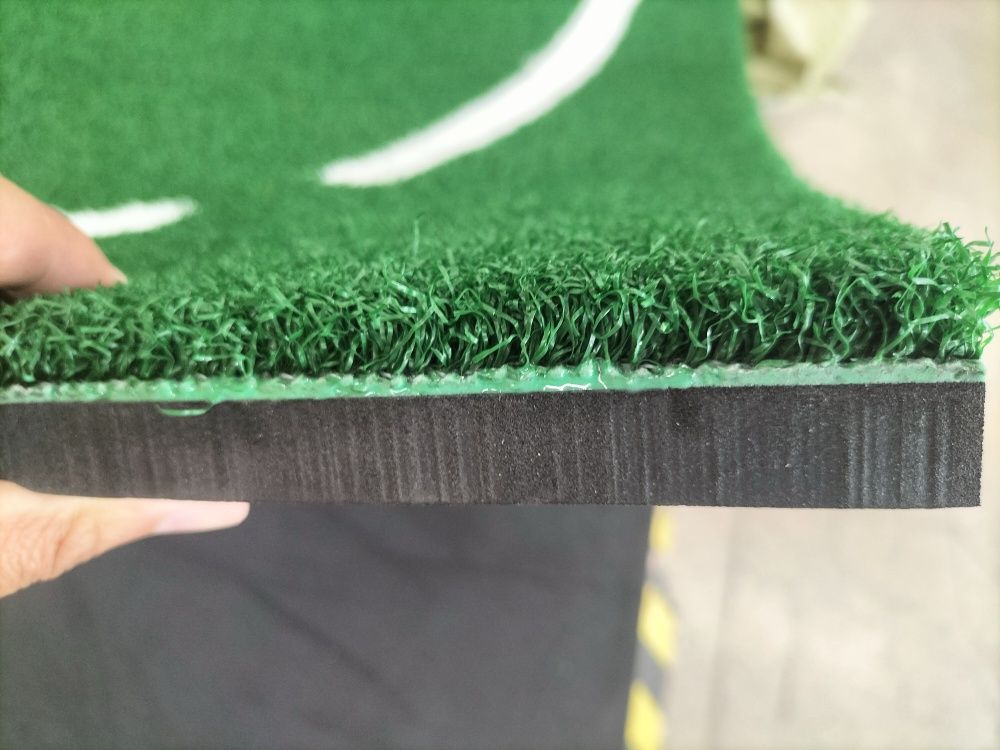
However, EVA also has some limitations. Because it is a foam material, its long-term resistance to heavy compression and repeated impact may be lower than that of high-density rubber materials. Under intensive commercial use, a lower-density EVA foam may gradually show compression, deformation or reduced resilience. Therefore, EVA golf mats need to be designed with an appropriate foam density and thickness when they are intended for frequent use.
For driving ranges, golf clubs and other high-traffic commercial facilities, the overall construction of the mat is especially important. A high-quality EVA base combined with a durable artificial turf layer can provide good performance, but the material specification should be selected according to usage frequency and expected service life.
NBR, or Nitrile Butadiene Rubber, is a synthetic rubber material known for its strength, flexibility, resilience and excellent resistance to repeated mechanical stress. NBR is widely used as a rubber backing or base material in premium golf hitting mats, commercial driving range mats and golf simulator mats.
One of the biggest advantages of NBR rubber is durability. A golf hitting mat used in a commercial driving range can experience thousands of swings, repeated club impact and constant foot traffic. NBR rubber provides a strong and resilient foundation that can help the mat maintain its shape and performance over a longer period.
NBR also provides excellent shock absorption. When the club strikes the mat, the rubber base helps absorb and distribute impact energy. This can improve the stability of the hitting mat and provide a more solid and comfortable hitting experience. For golfers who practice frequently, a well-designed NBR golf mat can provide a more consistent feel underfoot.
Another important advantage of NBR is its resistance to compression and deformation. Compared with softer foam materials, high-quality NBR rubber generally performs better under repeated loading. This makes it particularly suitable for commercial golf hitting mats, driving range golf mats and high-frequency golf training environments.
NBR also provides excellent grip and stability. A heavy rubber backing can help prevent the golf mat from sliding during a swing. This is particularly important for powerful swings, professional training and commercial golf facilities where mat movement can affect both safety and the consistency of practice.
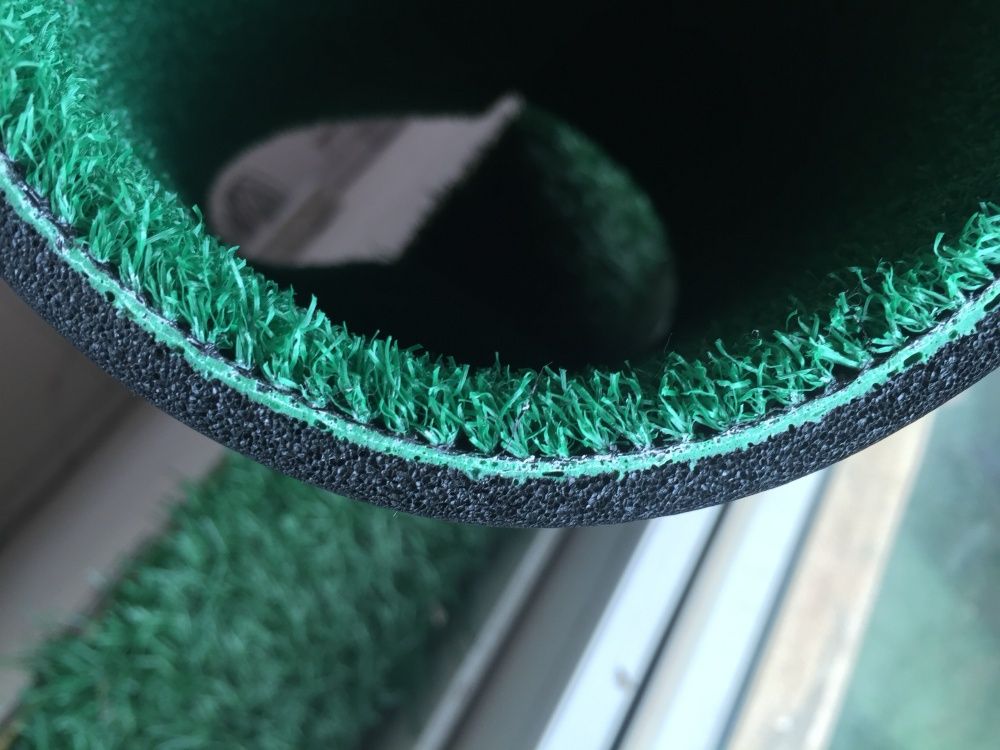
The main disadvantage of NBR is its weight. A golf mat with a thick NBR rubber base can be significantly heavier than a comparable EVA foam mat. This makes NBR mats less convenient to move or transport frequently. NBR is also generally more expensive than EVA, especially when a thicker and higher-density rubber base is used.
The most obvious difference between EVA and NBR is their material structure. EVA is a lightweight foam, while NBR is a flexible synthetic rubber. This structural difference affects weight, durability, cushioning, stability and cost.
EVA is generally the better option when lightweight construction, portability and cost efficiency are the main priorities. It can provide good shock absorption and comfortable cushioning while keeping the golf mat easy to handle.
NBR is generally the better choice when durability, stability, impact resistance and long-term commercial performance are more important. Its rubber structure provides a stronger foundation and better resistance to repeated compression.
In terms of weight, EVA has a clear advantage. EVA golf hitting mats are easier to carry, install and store. NBR golf mats are heavier, but this additional weight can improve stability and reduce movement during a golf swing.
In terms of durability, NBR generally has an advantage in high-frequency commercial applications. EVA can still provide excellent service life when the correct density and construction are selected, but low-density EVA may be less suitable for extremely heavy use.
In terms of shock absorption, both materials can provide good performance, but they deliver a different feel. EVA tends to provide a softer and more cushioned response, while NBR provides a combination of impact absorption, resilience and stability.
In terms of price, EVA is generally more economical, making it attractive for budget-conscious projects, residential golf practice and portable golf mats. NBR usually costs more, but its additional durability and stability can make it a worthwhile investment for commercial golf facilities.
The main advantages of EVA include lightweight construction, good cushioning, flexibility, easy transportation and competitive cost. EVA is particularly suitable for personal golf practice mats, home golf simulators, portable hitting mats and applications where the mat needs to be moved frequently.
The disadvantages of EVA are mainly related to heavy-duty performance. Depending on foam density and quality, prolonged high-frequency use may result in compression or loss of resilience. Therefore, not all EVA golf mats are suitable for busy driving ranges or commercial training facilities.
NBR's main advantages include excellent durability, strong impact resistance, good resilience, high stability and superior resistance to repeated compression. These characteristics make NBR rubber particularly suitable for commercial driving range golf hitting mats, professional practice facilities and premium golf simulator mats.
The disadvantages are higher weight and higher material cost. A thick NBR rubber base can make transportation and installation more difficult, especially for large-format commercial golf mats. However, for facilities where durability and long-term performance are priorities, the additional weight and cost can be justified.
There is no single material that is best for every golf hitting mat. The right choice depends on the application, frequency of use, required durability, budget and installation environment.
For home users and personal practice, EVA can be an excellent choice because it is lightweight, comfortable and easy to handle. It is also suitable for portable golf hitting mats where transportation and storage are important.
For commercial driving ranges, golf clubs and high-traffic training facilities, NBR is often a more suitable option because of its durability, stability and resistance to repeated impact.
For golf simulator mats, both EVA and NBR can be used successfully. EVA can provide a softer and more cushioned feel, while NBR can provide a firmer, more stable and durable platform. The ideal material also depends on the thickness of the base, turf quality, shock-absorbing layer and overall mat construction.
Material selection is only one part of golf mat performance. A high-quality golf hitting mat should combine a durable artificial turf surface with an appropriately engineered base. The turf should be resistant to wear and repeated club contact, while the base should provide sufficient shock absorption, stability and structural support.
For commercial golf hitting mats, the combination of high-quality turf and NBR rubber can provide excellent long-term performance. For portable and residential golf mats, EVA foam can offer a practical combination of comfort, lightweight construction and cost efficiency.
Ultimately, EVA and NBR each have their own advantages. EVA focuses more on lightweight cushioning, flexibility and affordability, while NBR focuses more on durability, stability, resilience and heavy-duty performance. By selecting the appropriate material according to the intended application, golf facility owners, distributors, wholesalers and golfers can achieve a better balance between performance, service life and overall cost.
Whether the requirement is a portable golf practice mat, driving range golf hitting mat, commercial golf mat or indoor golf simulator mat, understanding the difference between EVA and NBR helps ensure that the final product delivers the right combination of comfort, durability, stability and performance.